
Our Materials
Using nothing but materials from sustainable sources allows us to have the most positive environmental impact possible. Here are the four sustainable materials that we currently use to make our products:
"High uniform standards are indicative of the high standard that we have at our school."
Organic Cotton
Organic cotton really is a game-changer. It uses less water and less energy, whilst producing less CO2 than conventionally farmed cotton. Plus, it eliminates the use of GMOs and harmful pesticides. For all those reasons, 100% of our cotton is organic.

Recycled Polyester
We try to use as little plastic as possible, but for now, when we need to, we only use recycled and not virgin polyester. This means we use less energy and reduce our dependence on fossil fuels. It also diverts PET bottles away from landfills, reducing soil contamination and water pollution.

Regenerated Nylon
All of our swimwear is made from regenerated nylon. This starts out as disused fishing nets and then turns directly into our durable swimming trunks and costumes.

Cotton Blends
A cotton blend refers to a shirt that is typically made from 80% cotton and 20% polyester, linen, or rayon. Polyester/cotton blends tend to be stronger than pure cotton fabrics while offering a wider variety of usable textures.

Textile Industry's on the Environment
The textile industry is one of the largest polluters worldwide. It is responsible for massive textile waste, greenhouse gas emissions, water, air, and soil pollution.

To further impact the situation, fast fashion is being produced at an accelerated rate, and manufacturers are relying on virgin synthetic materials that are cheap and quick to produce to keep up with cost and demand. These fabrics take decades to biodegrade and are a contributor to why textiles make up 7.7% of municipal solid waste in landfills.

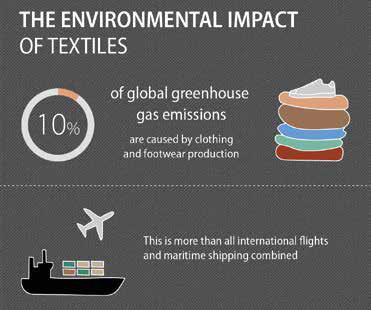
Of global greenhouse gas emissions are caused by clothing and footwear production. This is more than all international flights and maritime shipping combined.
Sustainability within the Textile Industry
Sustainability within the textile industry is a complex topic. Most materials require resources to produce which somehow impacts the environment.
As with most sustainable materials, there are both positives and negatives, but going down a sustainable route will help reduce the impact the textile industry is having on the environment.

Manufacturers need to approach sustainability from many angles. If using recycled fabric or organic fabrics were a simple process, most brands and manufacturers would already be doing so.
Unfortunately, it is a few selected brands that are using fully recycled fabrics and have customers that are willing to pay higher prices for this.

What is Threads doing for the Environment?
One of the benefits of using a school uniform is the value of timeless garments. Unlike fast fashion, uniforms do not need to be changed often.
Threads' mandate from 2017 has been to produce fabrics that are functional, practical, durable, cost-effective, and sustainable. We are working extensively with our partner factories to research and develop fabrics that tick all the above boxes. With this in mind, Threads have embarked on a short, medium, and long-term plan which ultimately will result in products that are fully sustainable to customers.

Materials that are Being Used by Threads

The obvious element in the school uniform to change would be the fabrics that are used. Threads, with their partner factories, have invested and have been researching & developing cost-effective sustainable fabrics.
Our research has shown that there isn't one dream fabric to solve every problem. Specific garment categories require different types of fabrics. Organic fabrics and recycled synthetic fabrics are viable options
The Current breakdown of types of fabrics used are as follows:
- 39% : PE Kits / Core Accessories (Recycled Polyester)
- 24% : Bottoms (Polyester Blend)
- 13% : Shirts / Polo Tops (Cotton Blend)
- 14% : Standard Shirts (Viscose Blend / Cotton)
- 6% : Jackets (Polyester Blend)
- 3% : Winter Pullovers (Acrylic Blend)
- 1% : Footwear Component parts (Natural Recycled Rubber)
Organic Cotton to replace Cotton
- Produced without toxic pesticides.
- Organic certifications are expensive. In some cases, organic cotton production uses more resources
- It results in a lower yield, making it less efficient and generating less revenue.
- The cost currently is 20-30% more than virgin cotton.
Recycled Polyester to replace Virgin Polyester
- 49% of the world's garments are made from polyester.
- Recycled polyester is created by recycling plastic water bottles that have been broken down into fibers.
- Many garments are not made from polyester alone, but rather a blend of polyester and other materials. In that case, it is more difficult, if not impossible, to recycle them.
Viscose
- Viscose is a semi-synthetic raw material. It is made in a chemical process from cellulose, which is contained in wood. No petroleum is used in the production.
- Conventional viscose is not sustainable because the chemical process is extremely energy-intensive.
- It is soft, cheap, and climate-regulating.
Bamboo (Alternative fabric)
- It is a fast-growing regenerative crop. It is touted as a sustainable material when mechanically processed.
- However, the chemicals used to process the fabric are harmful to human health and the environment.
- Bamboo fabric tends to shrink at a faster rate compared to cotton.
- Natural bamboo fabric tends to be more expensive than the rayon type or even cotton.
We have to consider input vs output.
Is there enough information out there for the customer to jump on board with the idea to invest in a fabric that is eco-friendly while accepting the cost involved?
How can we educate the parent and in this case most importantly the student, to start understanding the long-term effects of sustainability by simply starting with their uniform?
The challenge facing sustainability is the COST vs AVAILABILITY (of machinery & materials). Recycling machinery is expensive and not readily available. Sustainable fabrics are in short supply and are expensive.

How are Threads Factories Contributing?
The majority of Threads' product comes from China. It is commendable that the Chinese government is taking a leading role in sustainability. China's long-term goal is to become carbon neutral by 2060.
They have been facing the issue head-on with strict environmental regulations and have begun making progress. Changes and revisions in environmental law have increased since 2014 with more than 20 new environmental laws adopted.

In keeping with this commitment, environmental officials have taken a proactive approach by inspecting all of China's factories to ensure that environmental laws are adhered to. Temporary shutdowns, hefty fines, and jail time are just some of the punishments set out for non-compliant factories.

China has since become the world's largest investor, producer, and consumer of renewable energy worldwide, manufacturing state-of-the-art solar panels, wind turbines, and hydroelectric energy facilities, as well as becoming the world's largest producer of electric cars and buses.
In 2021, China implemented further fiscal policies for supporting the country's climate targets, which include funds, tax incentives, investment, and green procurement among other measures.
Water Treatment
- Rainwater is collected and used in cooling, dyeing, and production.
- Industrial water reuse and recycling has a 90% recovery rate.

Chemicals & Dyes
- Moving away from chlorine-based dyes to more biodegradable chemicals.
- Biological treatments have been adapted for the removal of dyes & chemicals from waste.
- The Chinese government regulates the type of dyes and chemicals that are allowed to be used, and factories strictly adhere to this.
- Over and above this, garments are 3rd party tested to ensure that they are safe for wear.

Threads - Where We Are Currently?
Research & Development into sustainable fabric is progressing. We have replaced some of the Polyester fabrics with Viscose options.
Threads are currently using Packaging that is biodegradable, and cartons that are recycled.
Partner factories are committed to ensuring that they are using safe and acceptable practices.

Short-Term Goal
Part of the short-term plan is to have the remainder of the trims on the garments (i.e., tags, labels, etc.) be fully sustainable.
Mid-Term Goal
As the world continues to understand the importance of sustainability, so too is the advancement in materials and machinery in this area. Governments are expected to provide incentives to clear the path for sustainable development.
We expect the gap between sustainability acceptance and cost to be dramatically narrowed, making it easier for customers to choose Eco-friendly products.
Transportation
Improve our lead times, thus reducing the need to air freight orders (reduces carbon footprints).
Education
Educating consumers about sustainability doesn't always have the desired effect.
The focus has to shift toward the younger generations. Educating scholars is the key to improving the long-term effects of sustainability.
Recycling Old School Uniforms
Find initiatives for re-used apparel/uniforms. This could also be a key piece in the education of textiles.
An option for this would be to hand over used uniforms to less-fortunate students.
Long-Term Goal
The ultimate goal for Threads is to produce and supply products that are fully sustainable.
From materials that are produced using organic means or produced from recycling, if the textile industry wants to make conscious progress without further endangering nature, Governments and industries should implement manufacturing practices that reduce carbon footprint, invest in research & development to use sustainable raw materials, and produce environment-friendly finished products.

Eco-Conscious Use
Eco-conscious is a term used to describe an awareness and understanding of the environment and its sustainability. It involves being mindful of the ways in which our actions can have a positive or negative impact on the environment, and taking steps to reduce our individual and collective impact. This can include reducing energy consumption, conserving resources, utilizing renewable energy sources, and recycling.

Eco-consciousness also involves being aware of the environmental policies of businesses, governments, and other organizations, and supporting those that prioritize environmental protection.
